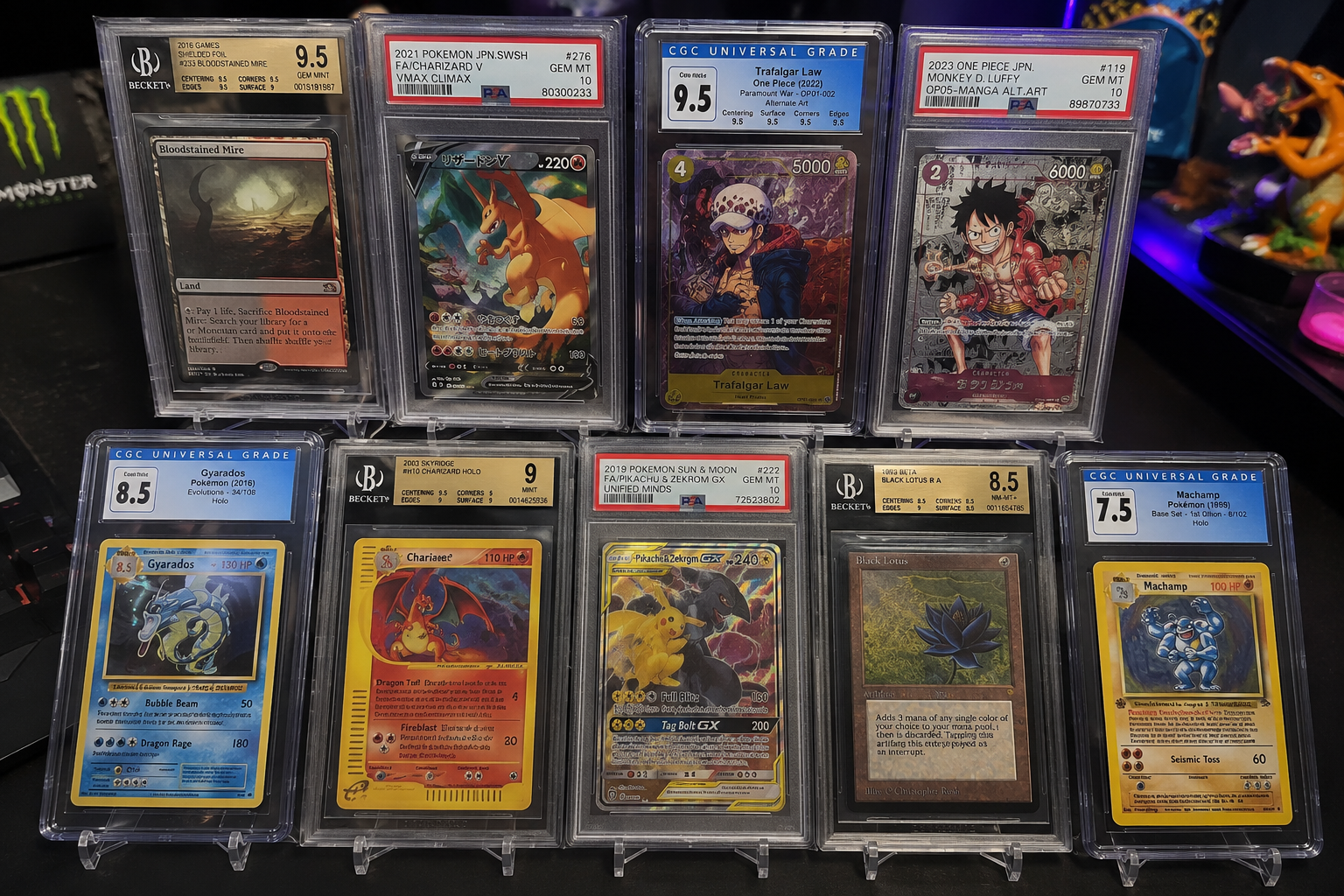
TCG Card Grading Guide for Beginners
Card grading has become an important part of collecting trading card games such as Pokémon, Magic: The Gathering, Yu-Gi-Oh!, One Piece, Disney Lorcana and Dragon Ball Super Card Game.
Submitting a card for grading can help confirm its authenticity, assess its condition and protect it inside a rigid plastic holder. However, not every card needs to be graded, and certification does not automatically increase its value.
In this beginner’s TCG card grading guide, we explain how the process works, what graders evaluate, how to choose a grading company and how to decide whether a card is worth submitting.
What Is TCG Card Grading?
Card grading is a process in which a specialist company examines a trading card and assigns it a numerical score based on its condition.
After the assessment, the card is usually sealed inside a rigid plastic case commonly known as a slab. The label at the top normally contains information such as:
- Card name.
- Set or expansion.
- Year of release.
- Card number.
- Language or variant.
- Final grade.
- Certification number.
The slab protects the card and allows collectors and buyers to understand its assessed condition without relying only on a seller’s description.
Why Do Collectors Grade Trading Cards?
There are several reasons to submit a card for professional grading.
Authentication
The grading company examines the card for possible counterfeiting, alteration or manipulation. This can be particularly valuable for older, promotional or expensive cards.
Condition Assessment
The card receives a grade based on its condition. This helps distinguish between a generally well-preserved card and a copy considered to be in nearly flawless condition.
Protection
Once encapsulated, the card is protected from direct handling, dirt, scratches and some forms of accidental damage.
A slab does not make the card indestructible. It should still be kept away from humidity, extreme heat, impacts and prolonged exposure to sunlight.
Easier Buying and Selling
A certified card may be easier to sell because its condition has been assessed by an independent company. Its market value will still depend on demand, rarity, the grade received and the reputation of the grading service.
How Are Trading Cards Graded?
Most grading companies use a numerical scale that generally reaches 10. A higher number indicates a card considered to be in better condition.
As a broad guide:
- 10: exceptional or nearly perfect condition.
- 9: excellent condition with very minor flaws.
- 8: very good condition with some visible imperfections.
- 7 or lower: more noticeable wear, damage or manufacturing defects.
Each company has its own standards, labels and terminology. A grade of 10 from one company may not be considered exactly equivalent to a 10 from another.
Receiving the highest grade can be difficult, even with a card taken directly from a booster pack. New cards may still have poor centering, print lines or other factory defects.
What Do Card Graders Evaluate?
Although the exact criteria vary between companies, most grading systems focus on four main areas.
1. Centering
Centering refers to the position of the artwork and borders on the card.
A well-centred card has balanced margins on both the front and back. When one border is noticeably wider than another, the final grade may be affected.
Poor centering is one of the most common reasons why a pack-fresh card does not receive the highest possible grade.
2. Corners
All four corners should be sharp and free from visible wear.
Graders may look for:
- White marks.
- Small impacts.
- Bends.
- Rounded corners.
- Separation between the layers of the card.
Cards with dark backs or highly sensitive edges may show whitening more easily.
3. Edges
The edges are examined for wear, irregular cutting and damage.
Common issues include:
- White spots.
- Colour loss.
- Small chips.
- Rough factory cuts.
- Raised or damaged edges.
Inspect the entire card under consistent lighting, as some imperfections are only visible from a particular angle.
4. Surface
The surface assessment covers both the front and back of the card.
Graders may identify:
- Scratches.
- Fingerprints.
- Stains.
- Dents.
- Print lines.
- Loss of gloss.
- Pressure marks.
- Dirt.
- Creases or folds.
Small dents can be especially important. They may be difficult to notice at first but can have a significant effect on the final grade.
What Are Subgrades?
Some grading companies offer individual scores for each part of the assessment. These separate scores are known as subgrades.
A label with subgrades may show different results for:
- Centering.
- Corners.
- Edges.
- Surface.
Subgrades make it easier to understand which area prevented the card from receiving a higher overall score.
Not every company offers them, and they may carry an additional cost.
Major TCG Card Grading Companies
There are many companies offering trading card authentication and grading. Some of the most widely recognised international names include PSA, Beckett and CGC.
Before choosing a company, compare:
- Reputation within the collecting community.
- Recognition among buyers.
- Slab design and durability.
- Grading standards.
- Availability of subgrades.
- Service cost.
- Estimated turnaround times.
- Shipping fees.
- Insurance options.
- Ease of submission from Spain or elsewhere in Europe.
European grading companies may provide simpler submissions or lower shipping costs. However, a less widely recognised company may have a smaller effect on the card’s resale value.
The best choice depends on whether you want to protect a personal collection, sell a card, authenticate an older piece or attempt to obtain a high grade.
Which Trading Cards Are Worth Grading?
Not every card needs professional grading. Consider both its condition and importance before submitting it.
A card may be a good candidate when:
- It is rare, old or difficult to obtain.
- It has strong collector demand.
- It is an important promotional card.
- It has good centering and very few visible flaws.
- It has significant sentimental value.
- You want to preserve it for many years.
- There is a meaningful difference between its ungraded value and its value at a strong grade.
- You want professional authentication.
A low-value card may still be worth grading when it represents an important personal memory. Grading does not have to be used only as an investment strategy.
Which Cards Are Usually Not Worth Grading?
A card may not be worth submitting when:
- Its market value is lower than the total grading cost.
- It has visible scratches, bends or damage.
- It is clearly off-centre.
- Many similar graded copies already exist.
- It would only become valuable with a perfect grade.
- Collector demand is very limited.
- You intend to use it regularly in a deck.
Remember that the total cost includes more than the company’s grading fee. You may also need to pay for shipping, insurance, intermediaries and return delivery.
How to Decide Whether Grading Is Profitable
Before submitting a card, compare three figures:
- The approximate value of the ungraded card.
- The full cost of grading and shipping.
- The recent selling prices of graded copies at several different grades.
Do not compare your card only with copies that received a 10. It is more realistic to examine the value of grades such as 8 and 9 because there is no guarantee that your card will receive the highest score.
A card may look profitable if it earns a 10 but result in a loss if it receives an 8. Your decision should therefore be based on a realistic expected outcome.
Look at completed sales rather than only active listings. A seller can ask for an extremely high price, but that does not mean a buyer has paid it.
How to Inspect a Card Before Submission
Examine the card in a clean and well-lit area.
Useful tools include:
- A bright white light.
- A clean, smooth surface.
- A simple magnifying glass.
- A torch for checking reflections.
- Powder-free gloves, although clean and dry hands are generally sufficient.
View the card directly and from several angles. Check both sides and pay close attention to the corners, edges and possible dents.
Avoid touching the main surface. Hold the card carefully by its edges.
How to Prepare a Card for Grading
Submission requirements vary between companies, so always check the selected grader’s current instructions before shipping.
The preparation process usually includes:
- Placing the card inside a PVC-free soft sleeve.
- Inserting it into an approved semi-rigid card holder.
- Avoiding adhesive tape directly on the sleeve or holder.
- Adding a removable pull tab when permitted.
- Placing the cards between two rigid pieces of cardboard.
- Securing them without applying excessive pressure.
- Adding bubble wrap or similar protective material.
- Using a sturdy shipping box.
- Including any required paperwork.
- Selecting an appropriate and, where necessary, insured shipping service.
Rigid toploaders are not accepted by every grading company. Check the required holder type before preparing your package.
Mistakes to Avoid When Submitting Cards
Common mistakes can damage a card or complicate the submission process:
- Cleaning the card with chemical products.
- Attempting to repair corners or edges.
- Scraping stains from the surface.
- Using a sleeve that is too tight.
- Placing adhesive tape close to the card.
- Sending the card loose inside an envelope.
- Using an oversized box without sufficient padding.
- Declaring an inaccurate value.
- Failing to photograph the card before shipping.
- Ignoring the grading company’s instructions.
Attempts to press, recolour, restore or alter a card may result in rejection or an altered-card designation.
Does Grading Always Increase a Card’s Value?
No. Grading does not automatically make a trading card more valuable.
The result depends on factors such as:
- The grade received.
- The grading company.
- Demand for the character or set.
- The card’s rarity.
- The number of graded copies available.
- The popularity of the game.
- The language and edition.
- The total submission cost.
A high grade can significantly increase demand for certain cards. A medium or low grade, however, may leave the card with a value similar to an ungraded copy.
Is It Better to Buy Graded Cards or Submit Them Yourself?
Buying an already graded card allows you to know the exact grade before paying. It also removes the risk of receiving a lower result than expected.
Submitting a card yourself may be more affordable when you purchased it at a good price and believe it is in excellent condition. It also adds the excitement of discovering the final grade.
For beginners, buying an inexpensive graded card can be a useful first step. It allows you to examine a slab, understand the label and compare graded cards before making your own submission.
How to Store Graded Cards
Even after encapsulation, graded cards require proper care.
Store slabs:
- Away from direct sunlight.
- In a dry environment.
- Away from heat sources.
- In a stable position.
- Inside sleeves or storage boxes designed for slabs.
- Without heavy objects placed on top.
You can also use stands, displays or cabinets, provided that the cards are not exposed to harmful conditions.
Grading Should Match Your Collecting Goals
TCG card grading can provide authentication, protection and a professional condition assessment, but it is not essential for enjoying a trading card collection.
Before submitting a card, examine its condition, compare recent sales and calculate every cost involved. Do not make the decision based only on the possibility of receiving a perfect score.
A card can still be special without being graded, and a collection does not need to be filled with slabs to have value. Choose the storage and certification method that best matches your goals.
At ThionaShop, you can find trading cards, sealed products and protective accessories for Pokémon, Magic: The Gathering, Yu-Gi-Oh!, Disney Lorcana, One Piece, Dragon Ball and other TCG collections.
← Volver al blog